Delegate365-Working with License Assignments

Delegate365-Working with License Assignments

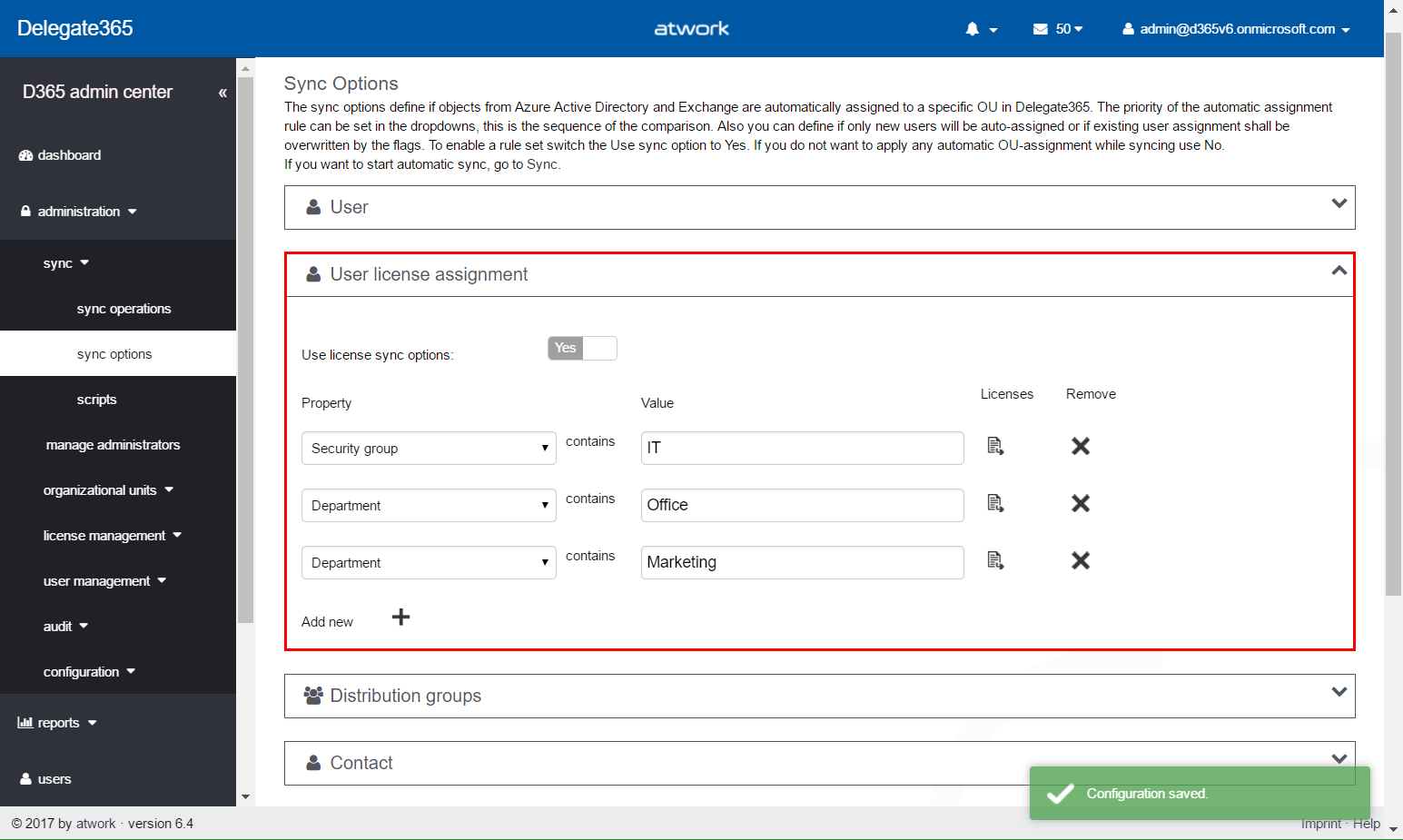
Delegate365 provides various automation tasks. One of these is the new License Assignment rule to automatically assign Office 365 licenses to users based on their user properties or on their group membership. See how this works in real world with a demo scenario here. The License Assignment is available since version 6.4. For details, pls. see the description here. This new feature allows to assign Office 365 licenses in a very custom way to users and runs at each Delegate365 synchronization operation, So, whenever a SyncOp runs, Delegate365 checks the sync rules and assigns licenses as specified. So let’s see how this works step-by-step as follows. ...

June 29, 2017 · 7 min · Toni Pohl
Delegate365 changelog version 6.5-Service health, logging and more

Delegate365 changelog version 6.5-Service health, logging and more

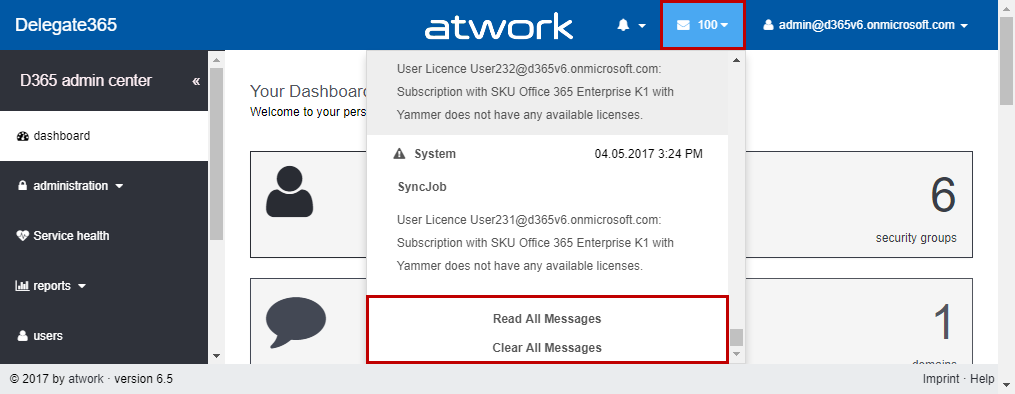
Delegate365 version 6.5 is here soon. With that update, there comes new functionality and some further improvements. Read the details here. Notification center: Now, the notification center shows just the last 100 messages (instead of all unread messages) to reduce the loading time for all unread messages that can be produced in a large number by the synchronization process. Anyway, you can access all messages as before by clicking the “Read all messages” link. “Clear all messages” sets all messages to “read”, so that they no longer show up in the notification center. This step improves the dashboard’s loading time. ...

June 28, 2017 · 6 min · Toni Pohl
Delegate365-Rerun the setup

Delegate365-Rerun the setup

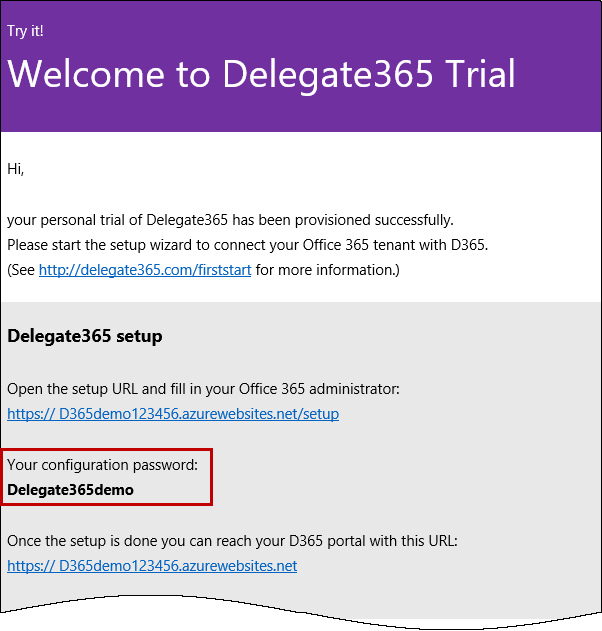
Delegate365 runs as an app in Microsoft Azure on top of Office 365. You can connect to any Office 365 tenant with your Delegate365 portal. You just need a configuration password and a Global Admin user of your Office 365 tenant. The Setup must be executed once, as initial setup or during operation to renew the permissions of the Delegate365 app. See how the new and simplified setup process works here. ...

June 27, 2017 · 4 min · Toni Pohl
Delegate365-Working with Audit Logs

Delegate365-Working with Audit Logs

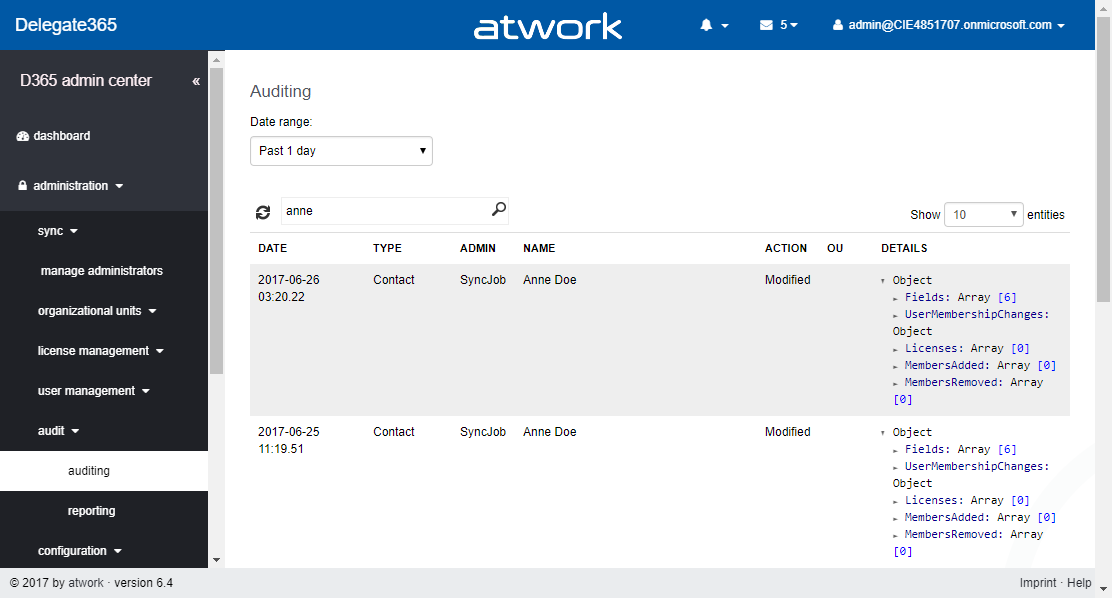
Delegate365 protocols all modifications of users, licenses and groups within the solution. This is essential to comprehend actions accomplished by Delegate365 administrators or by automated tasks. See how to work with that audited data here. So, all actions are logged to the Delegate365 Audit Log. In the current versions, the audit logs are saved to an Azure Storage Account. There are three ways of working with the audit data: See audit data within Delegate365 Access the data directly with Microsoft Storage Explorer Connect to the data with tools as Microsoft Excel or Power BI All methods are available for Portal Admins in the *administration / audit *menu and are described here. ...

June 26, 2017 · 7 min · Toni Pohl
Delegate365 changelog version 6.4-automate additional licenses assignments

Delegate365 changelog version 6.4-automate additional licenses assignments

In Delegate365 version 6.2 update we added an important feature to save Delegate365 licenses. With this Delegate365 version, there comes a new, powerful feature for more Office 365 automation. The new version number is 6.4. No worries, you have not missed version 6.3, since this was an internal version for adding the new user license assignment feature, testing and fixes. Delegate365 version 6.4 will be rolled out in the next two weeks. So, what does this update do? ...

May 8, 2017 · 5 min · Toni Pohl
Delegate365 changelog version 6.2-license and further improvements

Delegate365 changelog version 6.2-license and further improvements

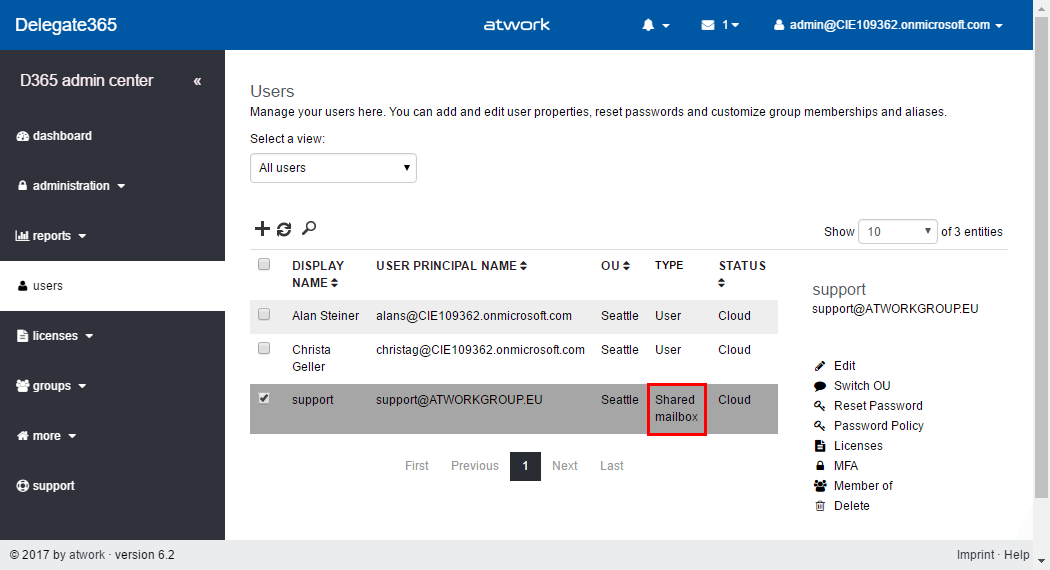
Delegate365 version 6.2 comes with some updates and improvements. See the new features described here. License counting update: Delegate365 is licensed per user that shall be managed. There comes just one peculiarity with that: shared mailboxes and resources are delivered from the Office 365 interface as users. This causes that D365 counts such users (but only) if they are assigned to an OU as well although they do not need to have an Office 365 license. So, this can lead to uncertainty, why licensing in D365 can be different from Office 365. Again, this is only the case if the user objects are assigned to an OU in D365. For more information about that topic pls. see Delegate365 license information (Q&A 4 to 6). With the new feature this behavior can be compensated and is obsolete. The following graphics shows such a scenario where a shared mailbox “support” is assigned to an OU in D365 (and counts as a D365 user license). We wanted to simplify that licensing in D365 to make it equal to Office 365 licensing in that specific case. With this D365 update, there come two new switches “Ignore shared mailbox users” and “Ignore resource users” in the administration / sync / sync options user region. By default, these two switches are set to “No”. This means, existing users for shared mailboxes and resources stay in the users list, as it was before. If set to “Yes”, this means that shared mailboxes and resources are ignored as “user” in D365. Such user objects that were existing in the users list will be removed from the users list. (No worries, nothing bad happens, they just no longer show up – and are not counted for D365 user licenses.) After the next SyncOp (of course, with “Use user sync options” switch to “Yes”), these user objects will no longer shown in the users list. The shared mailbox “support” is gone from the users list. Of course, the object is still manageable in the more / shared mailboxes list and can be managed there. The same goes for the resources. Our recommendation: Set both new switches to “Yes”. Usually there is no need to manage a shared mailbox or a resource in the same way as a user. With “Ignore shared mailbox users” and “Ignore resource users” activated, this saves D365 licenses. ...

April 7, 2017 · 4 min · Toni Pohl
Components of Delegate365

Components of Delegate365

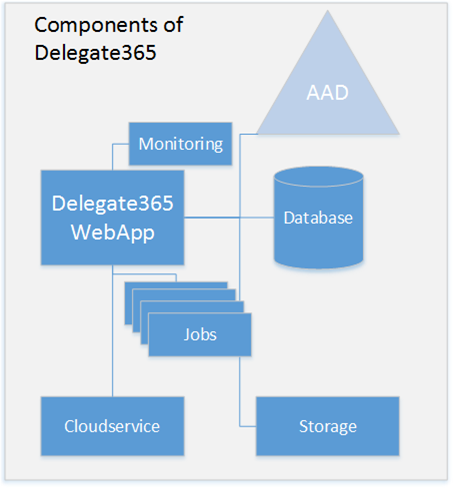
Since the beginning, Delegate365 developed to an extensive cloud solution for Microsoft Office 365. This article delivers a short overview about the components of Delegate365 in the Microsoft Cloud. The following graphics shows the involved Azure services that are used in D365. Delegate365 is using Platform-as-a-Service components that are maintenance-free. In detail, Delegate365 consists of the following Azure services. Web App – this hosts the Delegeate365 portal website. Jobs – these are tasks that run automatically in the background, currently these are the Synchronization Job, the License Aggregator Job, the Log Sink Job and the Sync Notifications. ...

February 27, 2017 · 2 min · Toni Pohl
Delegate365 changelog version 6.1-at a glance

Delegate365 changelog version 6.1-at a glance

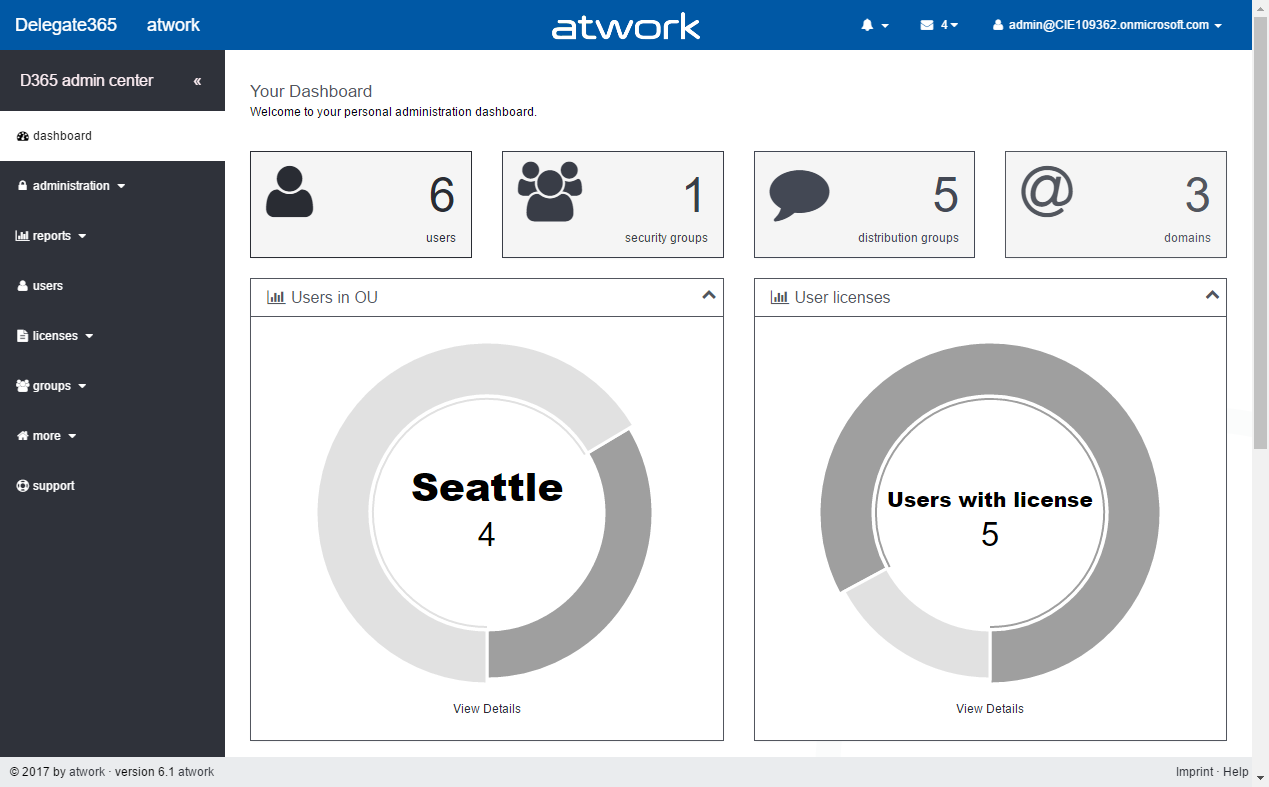
At the end of last year, Delegate365 version 6 was announced. We added a bunch of features and before updating all tenants, we wanted to improve some functionality. So it took some time to develop and test new features. Now it’s time to update all existing Delegate365 tenants to the latest version 6.1. See the most relevant news at a glance here! Important: Some customers are already using Delegate365 version 6. All D365 tenants will be upgraded to version 6.1 in the next days. All customers will also receive an email notification about the exact upgrade time. If you have any reservation against the D365 tenant upgrade time please contact us at support@atwork.at. ...

February 22, 2017 · 8 min · Toni Pohl
Delegate365 changelog version 6-Menu restructuring

Delegate365 changelog version 6-Menu restructuring

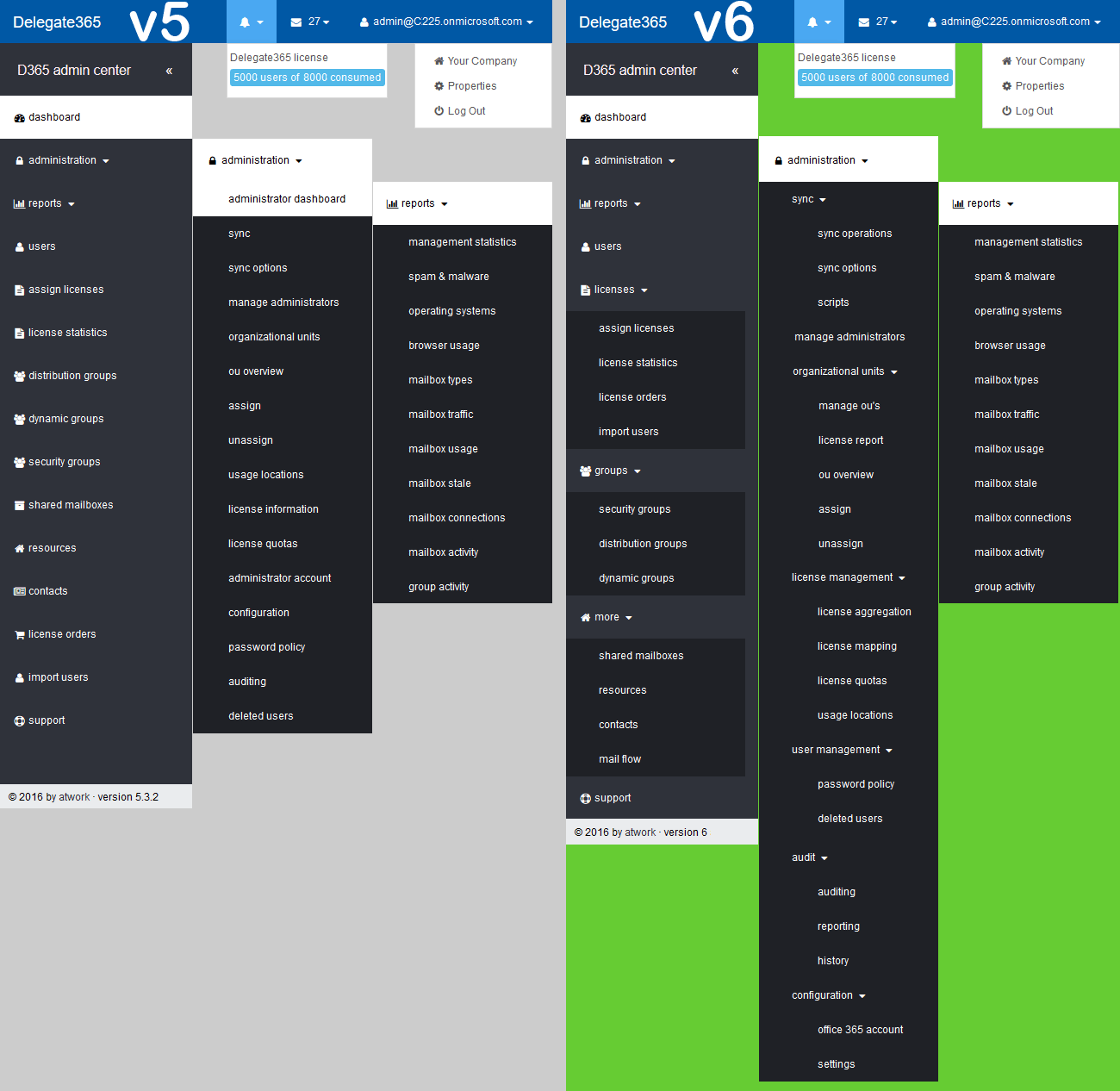
With Delegate365 version 6 there comes a slightly restructured menu. See the differences here. The existing left menu got a little bit disordered, so we reorganized it with groups to make it easier for admins to find related features. Enlarge the following graphics to see all menus and their new position. The left side (gray) shows the menu of D365 version 5, the right side (green) shows the new menu D365 version 6. ...

January 17, 2017 · 2 min · Toni Pohl
Delegate365 changelog version 6-Logging

Delegate365 changelog version 6-Logging

Large tenants and many operations can produce large audit logs in Delegate365 since every operation and every sync jobs is protocolled. To optimize the logging and to offer export and further use of the operations data, the audit logging changes with this version. See the details here. Previous versions: Let’s have a look back into the logging in the past. In the early versions of Delegate365, the logging was done in a database which blew up the database (unnecessarily). So, with version 2, we changed the logging to simple text files in CSV format to make it very easy to work with the protocolled data, for example, in Microsoft Excel. This format is used up to Delegate365 version 5.x. ...

December 1, 2016 · 5 min · Toni Pohl